When something goes wrong inside your body, you do not want a brilliant generalist. You want the person who has seen your exact problem a thousand times. The general practitioner is wonderful for the first ten minutes. They listen, they reassure, they point you in a direction. But the moment the problem turns out to be specific, you want the cardiologist, the oncologist, the surgeon who does only this one operation and does it every single day.
Depth is what saves you. Breadth is what greets you at the door.
Enterprise AI is at the same crossroads right now. The whole industry is selling one magnificent general practitioner. One enormous model that can talk about anything, reason about anything, and in a demo, do almost anything. It is genuinely impressive. And for the first ten minutes, it is exactly what you want. The trouble starts when the work gets specific, which in a real business is almost immediately.
The Generalist Knows a Little About Everything
A general model is trained to be capable across the entire surface of human knowledge. That is its strength and its ceiling at the same time. Ask it to draft a contract clause, reconcile an invoice, triage a support ticket, or read a clinical note, and it will give you a confident, plausible, mostly-right answer. Mostly-right is the problem. In a conversation, mostly-right is fine. In an operation, mostly-right is the gap between a process that runs itself and a process that quietly breaks in ways nobody notices until the quarter closes.
The reason is not that the model is weak. It is that the model has never specialized. It has read about your industry the way a smart medical student has read about every disease. Broad familiarity, no repetitions. It has never sat in your workflow, learned the exceptions your team handles on instinct, or absorbed the hundred small rules that are written nowhere but matter enormously.
A generalist can describe the surgery. A specialist has done it ten thousand times.
The Specialist Has Done This Ten Thousand Times
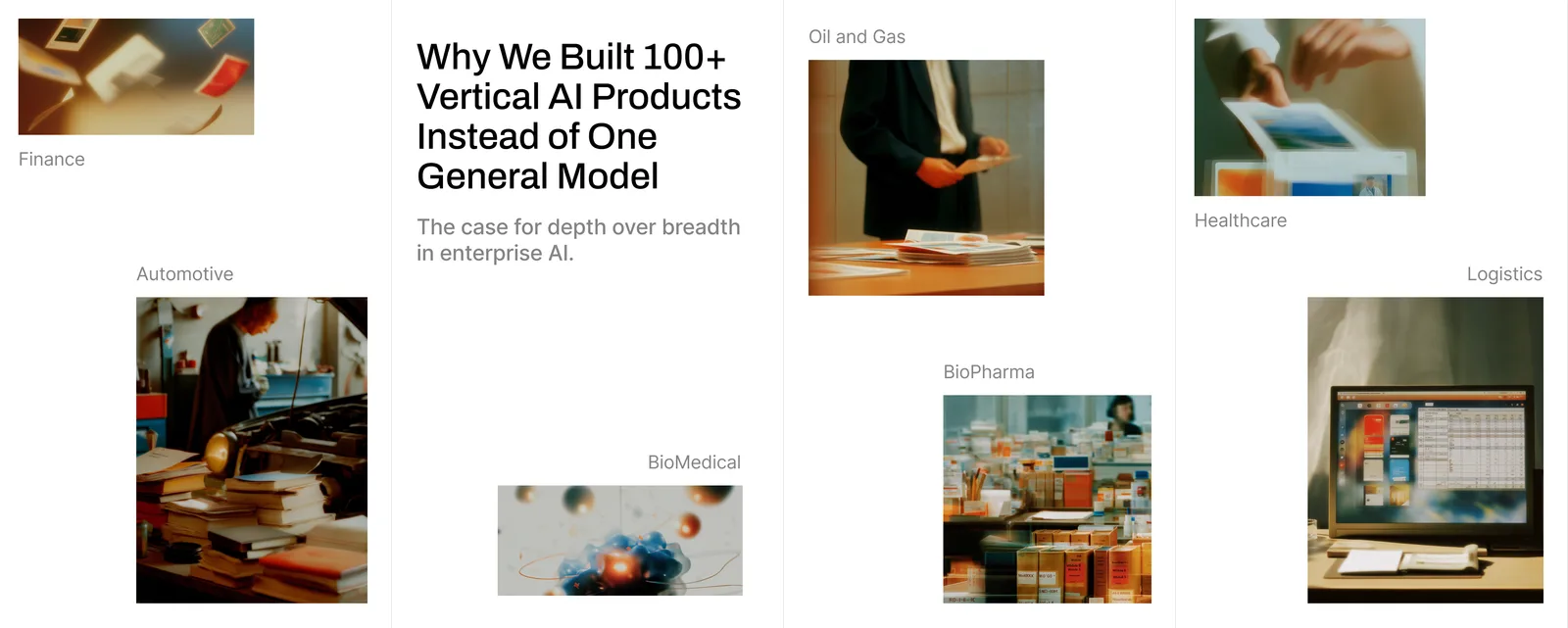
The alternative is a deliberate choice. Instead of building one model that tries to know everything, you build a hospital full of specialists. A hundred vertical AI solutions, each one trained and shaped around a specific job in a specific domain. Not a hundred toys. A hundred practitioners, each fluent in the language, the edge cases, and the unwritten rules of the work it was built to do.
Each of these solutions can sit on the same foundation, the same reasoning engine, the way every specialist in a hospital shares the same trained mind and the same medical education before they choose their field. The foundation is what makes them all capable. The specialization is what makes them useful. A radiologist and a cardiologist went to the same school. What separates them is ten thousand hours pointed at one thing.
That is the difference between knowing about a domain and knowing a domain.
Breadth Impresses. Depth Performs.
There is a reason the general model demos so well and deploys so poorly. A demo rewards breadth. You ask it ten different questions across ten different fields and it answers all of them, and you walk away amazed. But you do not run a business by asking one question across ten fields. You run a business by asking the same kind of question ten thousand times in one field, and getting it right every time.
Breadth wins the demo. Depth wins the year.
This is also why a hospital is not just a building full of clever people. It is a system. The specialists refer to each other, hand off cleanly, and cover the whole patient without any one of them pretending to do it all. A hundred vertical solutions work the same way. Each is excellent at its own job, and together they cover the full range of work a business actually does, without the fragility of asking a single generalist to be everything to everyone.
What This Says About Where We Are Going
Building a hundred specialists is harder than building one generalist. It takes longer, it demands real domain knowledge, and it does not produce a single magic box you can point at in a keynote. But the goal was never to win the demo. The goal is to do the work. The market is about to learn the same lesson medicine learned a century ago.
The future does not belong to the one who knows a little about everything. It belongs to the system that knows everything about something, a hundred times over.
